
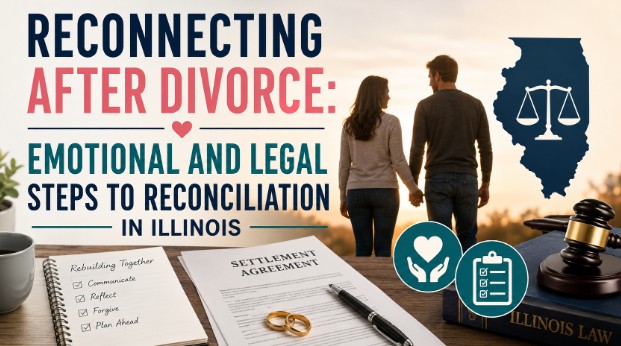
Approximately 6% of divorced couples remarry each other, and up to 60% of people going through the divorce process report being open to reconciliation at some point during proceedings, according to research cited by Dr. Mark Banschick in Psychology Today (2022).
Successful reconciliation requires addressing the root causes of the original divorce through personal growth, structured therapy, and honest communication — not simply rekindling emotional attachment.
Illinois imposes no waiting period to remarry after a finalized divorce, but remarriage triggers automatic legal consequences, including termination of maintenance under 750 ILCS 5/510, and requires formal court modification of existing custody orders.
Whether you are pausing an active divorce or considering remarriage after a finalized dissolution, Cooper Trachtenberg Law Group, LLC has guided Chicagoland families through these transitions since 1988. Schedule a free consultation at (847) 995-8800.
Divorced couples can and do reconcile, though success rates vary significantly depending on whether couples address the original causes of the divorce before reuniting.
Dr. Mark Banschick reported in Psychology Today (2022) that 10–15% of separated couples reconcile, and approximately 6% remarry each other after finalizing their divorce.
Among those who remarry the same spouse, roughly 30% divorce a second time — a rate substantially lower than the 60%+ divorce rate for second marriages to different partners.
Reconciliation, defined as the resumption of a committed relationship after separation or divorce, occurs along a spectrum. Some couples reconcile during active divorce proceedings before the final judgment is entered.
Other couples finalize their divorce, live separately for months or years, and later decide to remarry. The legal, emotional, and financial implications differ substantially between these two scenarios.
Dr. Howard Wineberg of Portland State University studied 506 women who attempted reconciliation and published results in the Journal of Marriage and the Family (1994). Wineberg found that 50% eventually divorced, 44% remained with their spouse at the time of the survey, and only 32% stayed together continuously for more than one year.
The research underscores a critical point: emotional desire to reconcile does not predict long-term success without structured work on the relationship problems that caused the original split.
| Outcome | Rate | Source |
| Separated couples who reconcile | 10–15% | Psychology Today (Banschick, 2022) |
| Divorced couples who remarry each other | ~6% | Psychology Today (Banschick, 2022) |
| Re-divorce rate (same spouse) | ~30% | Psychology Today (Banschick, 2022) |
| Re-divorce rate (different spouse, 2nd marriage) | 60%+ | Multiple academic sources |
| Reconciliation attempts that lasted 1+ year | 32% | Wineberg (1994), J. of Marriage and the Family |
| People in the divorce process are open to reconciliation | Up to 60% | Psychology Today (Banschick, 2022) |
If you’re ready to get started, call us now!
Emotional preparation begins with an honest self-assessment of what caused the marriage to end — not by contacting the former spouse. Reconciliation attempts that skip this step fail at significantly higher rates because they recreate the same conflict dynamics that produced the original divorce.
The Gottman Institute’s research on relationship repair identifies four specific behaviors — criticism, contempt, defensiveness, and stonewalling — as the primary predictors of relationship failure, and each requires targeted work before reconciliation can succeed.
Personal growth during the separation period forms the foundation for any credible attempt at reconciliation. Former spouses should ask themselves specific questions: What patterns did they contribute to the relationship’s breakdown?
What have they learned since the separation? How have they changed in measurable ways — not just in promises, but in demonstrated behavior over time? Evidence of personal growth carries more weight with a former spouse than verbal commitments alone.
Setting realistic expectations protects both parties from additional emotional damage. Rebuilding trust after divorce takes months or years, not days or weeks.
The process includes setbacks alongside progress. Warning signs that expectations remain unrealistic include expecting immediate forgiveness, avoiding difficult conversations about the past, rushing physical intimacy before emotional reconnection, and believing problems will disappear without directly addressing them.
A study by Hawkins published in the Journal of Divorce & Remarriage found that 75% of divorced couples report at least one spouse regretting the divorce within one year — but the gap between regret (75%) and actual remarriage (6%) reveals that emotional desire alone rarely produces lasting reconciliation.
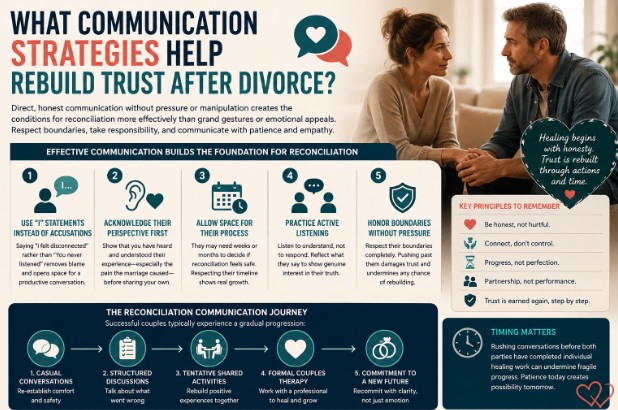
Direct, honest communication without pressure or manipulation creates the conditions for reconciliation more effectively than grand gestures or emotional appeals. Initial contact with a former spouse should respect boundaries, acknowledge past mistakes using specific examples rather than vague apologies, and express interest in reconnecting without placing expectations on the response.
Timing matters — rushing conversations before both parties have completed their individual healing work can undermine fragile progress.
Effective reconciliation communication follows specific patterns that relationship researchers associate with successful outcomes:
Couples who successfully reconcile typically describe a gradual progression rather than a single decisive moment: casual conversations first, followed by structured discussions about what went wrong, then tentative shared activities, and finally formal couples therapy before committing to remarriage.
If reconciliation conversations raise questions about custody, support, or property agreements already in place, Cooper Trachtenberg Law Group, LLC represents families across Cook, Lake, DuPage, Kane, and McHenry counties. Request your confidential consultation.
Structured professional therapy dramatically improves the success rate of reconciliation. The AAMFT’s 2012 survey found that 74% of couples who pursued therapy after a relationship crisis successfully recovered, compared to roughly 35–45% who attempted reconciliation without professional help.
One analysis found that only 15.6% of relationships survived a major crisis without any therapeutic support — making professional intervention the single most impactful step couples can take.
Individual therapy and couples therapy serve different functions during reconciliation:
When selecting a therapist for post-divorce reconciliation, couples should seek professionals who specialize in:
The commitment to therapy itself signals seriousness about changing the dynamics that caused the divorce. Research by Gordon, Baucom, and Snyder (2004) found that integrative approaches — combining individual emotional processing with couples communication training — produced the strongest outcomes across multiple study populations.
If you’re ready to get started, call us now!
Illinois imposes no waiting period between a finalized divorce and remarriage — couples can obtain a new marriage license immediately after the dissolution judgment is entered. The process for remarrying a former spouse follows the same requirements as any Illinois marriage:
Couples who reconcile before the final dissolution judgment is entered have a different legal path. The petitioner may voluntarily dismiss the case, thereby terminating the court proceedings and preserving the existing marriage.
Alternatively, Illinois courts can place the case on a “reconciliation calendar” to pause proceedings while the couple attempts to repair the relationship — preserving temporary orders regarding child support, custody, and property in case the reconciliation fails.
Annulment is distinct from both dismissal and remarriage. An annulment, called a “declaration of invalidity” under Illinois law (750 ILCS 5/301), treats the marriage as though it never legally existed. Illinois grants annulments only under specific conditions:
Annulment does not apply to couples who were validly married and subsequently divorced. Couples who have divorced and wish to reunite must remarry rather than seek annulment of the previous divorce.
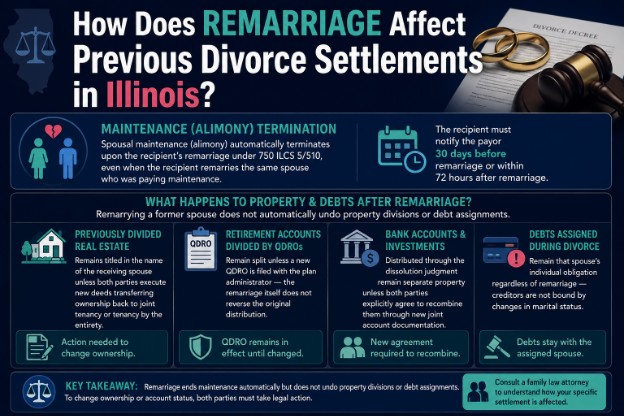
Remarrying a former spouse triggers automatic legal consequences for existing divorce agreements. The most significant is maintenance termination: spousal maintenance (alimony) automatically terminates upon the recipient’s remarriage under 750 ILCS 5/510, even when the recipient remarries the same spouse who was paying maintenance.
The recipient must notify the payor 30 days before remarriage or within 72 hours after remarriage.
Property already divided during the divorce does not automatically revert to shared status upon remarriage. Couples who remarry each other should work with a family law attorney to understand how each asset category is affected:
Child custody and child support orders established during the divorce remain legally enforceable until formally modified by the court, even if both parents resume cohabitation.
Reconciled parents must petition for modification under 750 ILCS 5/610.5 to update parenting time, decision-making authority, and support obligations.
Courts prioritize children’s stability, so demonstrating that reconciliation creates a beneficial environment for the children strengthens the petition for modification.
A prenuptial agreement before remarrying a former spouse provides legal clarity that protects both parties if the renewed marriage does not succeed. The 30% re-divorce rate among same-spouse remarriages — documented by Dr. Banschick in Psychology Today — means that roughly one in three renewed marriages ultimately ends again.
A prenuptial agreement addresses this statistical reality without undermining the emotional commitment of reconciliation.
A prenuptial agreement for remarriage to a former spouse typically addresses four categories of financial concern:
Illinois enforces prenuptial agreements under the Illinois Uniform Premarital Agreement Act (750 ILCS 10), provided both parties enter the agreement voluntarily, with full financial disclosure, and without unconscionable terms.
The conversation about a prenuptial agreement can feel uncomfortable between former spouses who are rebuilding trust.
Relationship experts recommend framing the discussion as mutual protection rather than distrust — both parties have experienced the financial disruption of one divorce and have practical motivation to establish clear terms.
An Illinois family law attorney can draft an agreement that reflects the unique circumstances of remarriage to a former spouse, including how previously divided retirement accounts, real estate, and business interests will be treated in the renewed marriage.
Reconciliation raises complex questions about property, custody, maintenance, and prenuptial protection — Cooper Trachtenberg Law Group, LLC, led by Miriam Cooper (practicing since 1988), guides Chicagoland families through every legal dimension of reconnecting after divorce. Book your confidential case review at (847) 995-8800.
What Percentage of Divorced Couples Get Back Together and Remarry?
Approximately 6% of divorced couples remarry each other, and 10–15% of separated couples reconcile before the divorce is finalized, according to research cited by Dr. Mark Banschick in Psychology Today. Among those who remarry the same spouse, roughly 30% divorce a second time — lower than the 60%+ rate for second marriages overall.
How Long Should You Wait Before Trying to Reconcile With an Ex-Spouse?
Wineberg’s research found that short-term separations of one week to one month preceded reconciliation attempts among childless couples, while couples with children tended toward longer separations of one month or more. Relationship therapists generally recommend completing individual therapy and demonstrating sustained personal change before initiating formal reconciliation discussions.
Does Couples Therapy Improve the Chances of Successful Reconciliation?
The AAMFT’s 2012 survey found that 74% of couples who pursued structured therapy after a relationship crisis successfully recovered and rebuilt the relationship. Without professional intervention, reconciliation success drops to roughly 35–45%, and one analysis found only 15.6% of relationships survived a major crisis without therapeutic support.
Is There a Waiting Period to Remarry Your Ex-Spouse in Illinois?
Illinois imposes no waiting period between a finalized divorce and remarriage. Couples can obtain a new marriage license immediately after the dissolution judgment is entered by appearing at the county clerk’s office with valid identification and paying the applicable fee, subject to the standard one-day license waiting period under 750 ILCS 5/203.
What Happens to Alimony if You Remarry Your Ex-Spouse in Illinois?
Spousal maintenance automatically terminates upon the recipient’s remarriage under 750 ILCS 5/510, even when the recipient remarries the same former spouse who was paying maintenance. The recipient must notify the payor 30 days before remarriage or within 72 hours after remarriage under the same statutory provision.
Do Child Custody Orders Change Automatically When Divorced Parents Reconcile?
Existing parental responsibility allocations remain legally enforceable until formally modified by the court, even if both parents resume cohabitation or remarry. Reconciled parents must file a petition for modification under 750 ILCS 5/610.5 to update parenting time, decision-making authority, and child support obligations.
Should You Get a Prenuptial Agreement Before Remarrying an Ex-Spouse?
A prenuptial agreement protects both parties, given that approximately 30% of same-spouse remarriages end in a second divorce. Illinois enforces prenuptial agreements under the Illinois Uniform Premarital Agreement Act at 750 ILCS 10, provided that both parties enter into it voluntarily, with full financial disclosure, and without unconscionable terms.
What Happens to Property Divided During Divorce if You Remarry Each Other?
Assets distributed through the original dissolution judgment remain the separate property of the receiving spouse and do not automatically revert to shared marital status upon remarriage. Retirement accounts divided by QDROs during the divorce remain divided unless a new QDRO is filed, and real estate titles require new documentation to reflect remarried status.
Can You Stop a Divorce in Illinois if You Decide to Reconcile During Proceedings?
Illinois law allows the petitioner to voluntarily dismiss a divorce case at any time before the court enters the final dissolution order. Courts can also place cases on a reconciliation calendar to pause proceedings while the couple attempts to repair the relationship, preserving temporary custody and support orders in case reconciliation fails.
What Are the Warning Signs That Reconciliation Will Not Succeed?
Reconciliation attempts are unlikely to succeed when one or both parties expect immediate forgiveness, avoid difficult conversations about the original causes of the divorce, rush physical intimacy before rebuilding emotional trust, or believe that problems will resolve without directly addressing them. Wineberg’s research found that only 32% of attempted reconciliations lasted beyond one year.
How Do Children Adjust When Divorced Parents Reconcile?
Children who experienced the original divorce may respond to reconciliation with confusion, hope, or anxiety about the reunion’s permanence. Relationship experts recommend age-appropriate communication about the reconciliation, family therapy to help children process the transition, and consistent reassurance that both parents remain committed to their stability and well-being.
Does Dating Other People Before Reconciling Affect the Outcome?
Relationship experts cited in Psychology Today noted that dating other people during the separation period can sometimes clarify feelings and strengthen the desire to return to a former spouse. The experience of new relationships provides a benchmark that helps individuals assess whether the strengths of the original marriage outweigh the issues that led to divorce.



About the Author
Founder of Cooper Trachtenberg Law Group, LLC · Illinois Family Law Attorney · Certified Mediator · Collaborative Divorce Practitioner
Miriam E. Cooper is the founder of Cooper Trachtenberg Law Group, LLC and an Illinois family law attorney with more than 30 years of experience helping individuals and families navigate divorce, custody, parenting time, child support, spousal maintenance, property division, and post-decree family law matters throughout the Chicago metropolitan area.
A certified mediator and collaborative divorce practitioner, Miriam completed mediation training through Northwestern University and serves clients through mediation, collaborative law, and litigation when necessary. She is also qualified as a Child Representative and Guardian ad Litem, allowing her to provide informed guidance in complex family law disputes involving children and families.
Drawing on more than three decades of family law experience, Miriam regularly advises clients on legal issues affecting Illinois families and is committed to helping clients reach practical, durable resolutions tailored to their unique circumstances.
Practice Areas: Divorce, Mediation, Collaborative Divorce, Child Custody, Parenting Time, Child Support, Spousal Maintenance, Property Division, Post-Decree Matters
Practice Areas
Legal Support When You Need It Most
Testimonials



Main Office
3601 Algonquin Road, Suite 610
Rolling Meadows, Illinois 60008
Lincolnshire Office
250 Parkway Drive, Suite 150
Lincolnshire, IL 60069
By Appointment Only
Phone:
847-995-8800


We represent parties across the Chicago area, including Arlington Heights, Barrington, Buffalo Grove, Carol Stream, Evanston, Glenview, Highland Park, Hinsdale, Inverness, Lincolnshire, Long Grove, Mt. Prospect, Palatine, Rolling Meadows, Schaumburg, Skokie, Streamwood, Wheeling and more. We also represent clients from Cook, Lake, DuPage, Kane and McHenry counties.
© 2026 by Cooper Trachtenberg Law Group, LLC. All Rights Reserved.
Disclaimer |
Site Map
